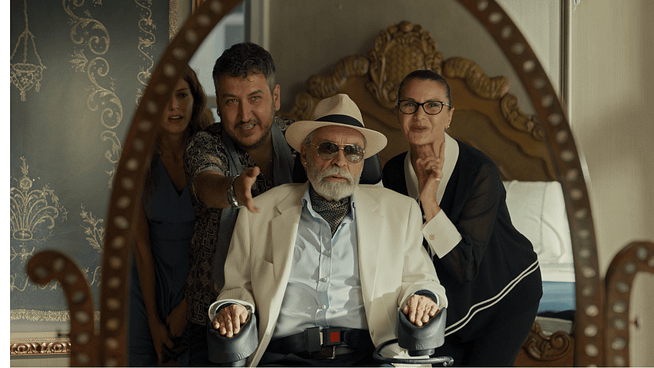
Soyut Dışavurumcu Bir Dostluğun Hikayesi Veyahut Yan Yana: A Masterpiece of Contrast
- Category: Dramatic Comedy, Biography
- Release Date: November 14, 2025
- Cast: Haluk Bilginer, Feyyaz Yiğit Çakmak, Bige Önal, Hatice Aslan, Şevval Sam
- Language: Turkish (English Subtitles Available)
- Duration: 2h 23m
- Director: Mert Baykal
Cinema is often a study of contrasts, but rarely do we see a collision of worlds as distinct as the one presented in Soyut Dışavurumcu Bir Dostluğun Hikayesi Veyahut Yan Yana (The Story of an Abstract Expressionist Friendship or Side by Side). Released on November 14, 2025, this film carries the weight of high expectations for two reasons: it is the official Turkish adaptation of the global French phenomenon The Intouchables (2011), and it unites two titans of Turkish entertainment who occupy opposite ends of the spectrum. On one side, we have Haluk Bilginer, an International Emmy winner and the epitome of dramatic gravitas. On the other, Feyyaz Yiğit, the king of modern absurdist humor and the mind behind the cult hit Gibi.
Directed by Mert Baykal and boasting the title of the first Turkish film to be released in IMAX, this production is not merely a remake; it is a cultural localization of a universal story. It asks the audience to look beyond class divides and physical limitations to find the shared humanity that binds us. For viewers on fmovies.tr, this is the most significant domestic release of late 2025, offering a runtime of nearly two and a half hours that flies by on wings of laughter and genuine tears.
The Plot: A collision of Two Turkeys
The narrative skeleton will be familiar to those who have seen the French original or its American counterpart, The Upside. However, the flesh and blood of this story are distinctly Turkish. The film introduces us to Refik (Haluk Bilginer), a wealthy aristocrat living in a gilded cage. Refik is a man of culture, refined taste, and immense fortune, but his life is shattered after a paragliding accident leaves him quadriplegic. He is paralyzed from the neck down, trapped in a body that no longer obeys him, surrounded by pitying staff and expensive art that he can look at but not touch.
Enter Ferruh (Feyyaz Yiğit), a man from the “other” side of the city. Ferruh is everything Refik is not: chaotic, unrefined, struggling with a criminal record, and possessing a unique, unfiltered view of the world. When Ferruh applies for the job of Refik’s live-in caregiver, he does so with zero expectation of getting hired. He is rude, dismissive, and treats Refik not as a fragile porcelain doll, but as a guy in a chair.
The Healing Power of irreverence
To the horror of his household staff and family, Refik hires Ferruh. Why? Because Ferruh is the only person who doesn’t look at him with pity. What follows is a “buddy comedy” structure that digs deep into the human psyche. Ferruh disrupts the sterile silence of Refik’s mansion with loud music, inappropriate jokes, and reckless adventures. Conversely, Refik introduces Ferruh to the world of abstract art, classical music, and discipline.
The script, co-written by director Mert Baykal and the brilliant Aziz Kedi, infuses the story with a specific flavor of Turkish humor. It tackles the class divide not with anger, but with satire. The bond that forms between them is not just about a caregiver and a patient; it is about two lonely men finding a reason to wake up in the morning.
Director’s Vision: Mert Baykal’s Grand Canvas
Mert Baykal is a director known for high production values (seen in works like Fi and Pera Palas), and he brings that cinematic sheen to Yan Yana. The decision to shoot in IMAX is a bold one for a dramedy. Usually, large formats are reserved for action blockbusters. However, Baykal uses the expanded aspect ratio to emphasize two things: the breathtaking, terrifying freedom of the paragliding scenes, and the suffocating isolation of Refik’s paralysis.
The camera lingers on Haluk Bilginer’s face—often the only part of him that can move—capturing micro-expressions that a standard screen might miss. Baykal also allows the comedic scenes to breathe. He understands that with a talent like Feyyaz Yiğit, you don’t cut quickly; you let the awkwardness of the dialogue linger until the audience is roaring with laughter. The pacing is deliberate, allowing the emotional weight of the third act to land with devastating impact.
The Cast: A Duet of Acting Styles
The success of this film rests entirely on the chemistry between its leads, and it is nothing short of magical.
- Haluk Bilginer as Refik: It is a challenge for an actor to perform without using their body language, hands, or posture. Bilginer delivers a masterclass in facial acting. His eyes convey a lifetime of regret, intelligence, and eventually, joy. He plays the “straight man” to Yiğit’s chaos, but possesses a dry wit of his own that makes their banter electric.
- Feyyaz Yiğit as Ferruh: Casting Feyyaz Yiğit was a risk. He is known for a very specific, deadpan, absurdist style of comedy. Yet, it works perfectly here. Ferruh is not a caricature of a “street thug”; he is a complex man masking his own insecurities with humor. Yiğit proves he has dramatic range, delivering the emotional beats as effectively as the punchlines. His reaction to “abstract expressionist art” is destined to become a classic scene in Turkish cinema history.
- Bige Önal: As the efficient and initially cold assistant, Önal provides the bridge between the two men. Her thawing relationship with Ferruh adds a sweet, romantic subplot that doesn’t overshadow the main bromance.
- Supporting Legends: Veterans like Hatice Aslan and Şevval Sam flesh out the world, providing context to Refik’s past and present.
Critical Review: More Than Just a Remake
Remakes are dangerous territory. If you stick too close to the original, you are unoriginal; if you stray too far, you lose the magic. Soyut Dışavurumcu Bir Dostluğun Hikayesi Veyahut Yan Yana navigates this tightrope with grace.
The “Gibi” Influence
The involvement of Aziz Kedi in the screenplay is palpable. The dialogue has that distinct rhythm found in the series Gibi—philosophical debates about mundane things, strange obsessions with minor details, and a refusal to embrace cliché melodrama. This prevents the film from becoming a cheesy “tear-jerker.” The emotional moments are earned because the characters feel like real, weird human beings rather than movie tropes.
Visuals and Soundtrack
The IMAX cinematography by the director of photography is stunning. The contrast between the cold, grey interiors of the mansion and the vibrant, chaotic colors of the Istanbul streets visualizes the class divide. The soundtrack, likely a mix of classical pieces (Ludovico Einaudi references from the original perhaps replaced or augmented by Turkish composers) and popular Turkish tracks, drives the emotional current of the film.
Yan Yana is a triumph. It validates the belief that universal stories can be retold if you give them a local soul. It is funny without being slapstick, and sad without being depressing. Haluk Bilginer reminds us why he is a world-class actor, and Feyyaz Yiğit solidifies his status as a cultural icon who can carry a blockbuster.
For the audience, the film offers a cathartic experience. It reminds us that friendship often comes from the most unexpected places. Whether you are there for the IMAX spectacle or the intimate character study, this film delivers. It is “Abstract Expressionism” in motion—messy, beautiful, and open to interpretation, but ultimately, deeply moving.